
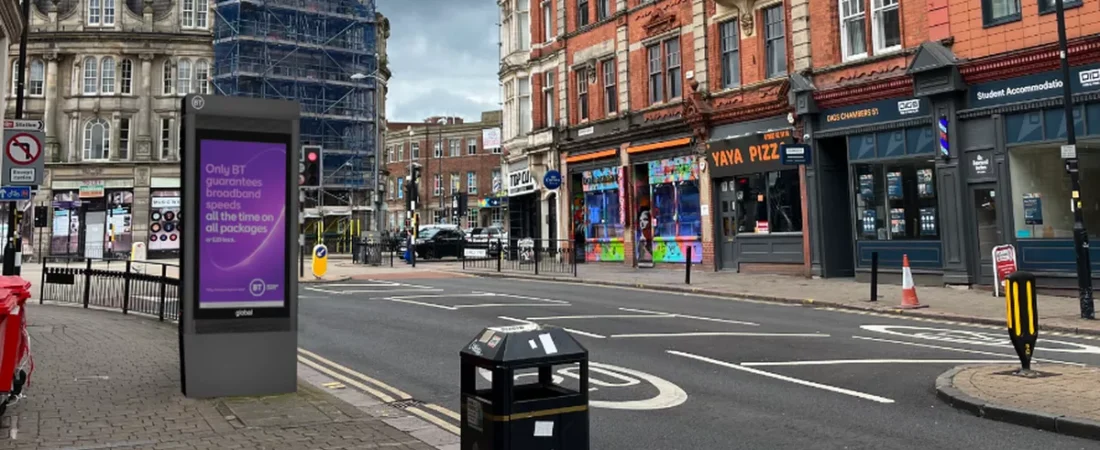

HOT IN THE CITY — Fully-Specced Hubs, Smart Infrastructure, and Precautionary Concerns
Introduction
Fully-specced street hubs are no longer just 21st-century street furniture. They are dense digital nodes, combining mobile connectivity, environmental sensors, USB charging, advertising panels, and smart-city integration.
From a legal and precautionary standpoint, these installations raise concerns in areas including: environmental impact, health risk uncertainty, regulatory compliance, planning, human rights, and urban infrastructure resilience.
This article uses Wolverhampton (2023–2025) as a case study, showing planning approvals, regulatory context, contested EMF claims, COVID-era debates, and the gaps that remain for precautionary law and policy.
Features of Fully-Specced Hubs
- Free public Wi-Fi and boosted 2G/3G/4G/5G coverage.
- USB charging ports, large advertising panels (often NHS and commercial).
- Connectivity for environmental sensors, IoT devices, and fibre networks.
- Links to digital frameworks including Internet-of-Bodies (IoB) concepts, digital currencies, and smart-city monitoring systems.
Note: IoB and “digital MAC code” claims remain speculative and are included to illustrate public concern.
Wolverhampton Examples — Planning & Deployment
- 18-metre 5G monopole — Sun Street & Wednesfield Road (June 2023)
Approved under prior-approval rules; deployed by Cignal Infrastructure UK (Three). [1] - 20-metre 5G mast + base cabinets — Linthouse Lane, Wednesfield (Dec 2023)
Installed near green-belt land. [2] - Small-cell deployment on city centre street furniture (Feb 2023)
Eleven units installed on lamp-posts; enhances 4G/5G coverage. [3] - Refused 15-metre mast near Day Avenue homes (July 2023)
Rejected due to visual intrusion. [4] - 22.5-metre 5G tower near Aldersley Stadium (2025)
Initially rejected; approved on appeal. [5] - 20-metre 5G tower at Craddock Street, Whitmore Reans (2025)
Rejected by Council, approved on appeal. [6]
Policy and regulatory context:
- Digital Wolverhampton Strategy encourages smart streetlights and fibre deployment. [7]
- Permitted development rights allow masts up to 30 metres without full planning. [8]
Environmental & Urban Impact
- Adds to urban carbon footprint (electricity, materials, maintenance).
- Contributes to light, heat, and noise pollution.
- Dense deployment near water towers, high-rises, parks, schools raises involuntary exposure concerns.
- Reliance on electricity and broadband reduces resilience compared with analogue lines.
- Millimetre-wave propagation: short-range, beam‑forming, directional — explains dense deployment, line-of-sight requirements, and tree-cutting in urban areas.
Electromagnetic, Radiation & Health Concerns
- SAR testing uses outdated models (adult male head, distance from body, thermal-only measurement).
- No long-term studies on cumulative exposure in modern small-cell urban deployments.
- Dense networks increase cumulative exposure, which remains scientifically and legally untested.
- Insurance/underwriting reports suggest untested, uninsurable, unverifiable long-term risk. [9]
Water & Oxygen Absorption Frequencies
| Molecule | Formula | Key absorption frequencies |
|---|---|---|
| Water (vapour) | H₂O | ~22.235 GHz, ~183 GHz [10] |
| Oxygen | O₂ | ~60 GHz, ~118.75 GHz [11] |
Note: Claims that 5G resonates with body water or oxygen are unproven, included here for precautionary teaching.
Wavelengths of Mobile Signals
To understand propagation, divide the speed of light (~300,000 km/s) by the frequency:
| Mobile Generation | Frequency | Wavelength |
|---|---|---|
| 2G | 900 MHz | 0.333 m / 33.3 cm / 333 mm |
| 3G | 2100 MHz | 0.143 m / 14.3 cm / 143 mm |
| 4G | 2600 MHz | 0.115 m / 11.5 cm / 115 mm |
| 5G (FR1, sub-6 GHz) | 3.5 GHz | 0.086 m / 8.6 cm / 86 mm |
| 5G mmWave | 26 GHz | 0.0115 m / 1.15 cm / 11.5 mm |
| 5G mmWave | 60 GHz | 0.005 m / 0.5 cm / 5 mm |
Example: An 868 MHz device has a wavelength of ~0.345 m (34.5 cm / 345 mm).
COVID-era Context
- Some linked dense 5G deployment to respiratory or oxygen-like symptoms during the pandemic.
- No causal link exists; illustrates public concern and precautionary principle.
- Planning relaxations included streamlined prior-approval pathways, reduced consultation, and faster rollouts.
Legal, Constitutional & Human Rights Framework
- Common law: potential nuisance or interference claims.
- Human Rights Act 1998: Article 8 (private/family life), Article 2 (right to life).
- Courts do not recognise proven 5G health harm; submissions must be precautionary/speculative.
- International law / precautionary principle supports transparency and monitoring.
Framing Precautionary / Policy Submissions
- Emphasise long-term uncertainty and cumulative exposure.
- Mandatory long-term monitoring, insurance, and liability coverage.
- Community consultation, public consent, democratic oversight.
- Resilience risk: electricity/broadband dependence, visual, heat, light, noise, environmental impact.
- Millimetre-wave realities: short distance, directional beam, tree-blocking.
Pedagogical & Training Value
- Distinguish regulatory compliance vs scientific certainty.
- Understand burden of proof, causation, human-rights law.
- Draft precautionary policy submissions.
- Evaluate infrastructure, environmental, cumulative exposure risk.
- Apply legal reasoning to public concern and policy gaps.
References
- Sun Street 5G monopole
- Linthouse Lane mast
- City centre small-cells
- Day Avenue mast refused
- Aldersley Stadium tower appeal
- Craddock Street tower appeal
- Digital Wolverhampton Strategy
- UK planning rules for 5G masts
- Workers of England — 5G concerns
- NASA water absorption
- Bristol University oxygen absorption
Wavelength Calculator
Enter any frequency between 1 Hz and 100 GHz and the calculator will display the wavelength in metres, centimetres, and millimetres.
FAQ & Further Reading
Further Reading
This reading list combines official international publications, national regulatory material, urban-policy frameworks, and a separate section containing non-official documents used exclusively for critical educational analysis. These sources support comparative study of planning law, digital infrastructure, public health, and the use of documents in litigation and public objections.
- World Health Organization – Electromagnetic Fields & Public Health
- UK Government / UKHSA – 5G Technologies: Radio Waves & Health
- ICNIRP – International EMF Exposure Guidelines
- FCC (USA) – RF Safety
- ACMA (Australia) – EME Checker & Public Resources
- ARPANSA (Australia) – 5G & EMF Resources
- ANSES (France) – 5G & RF Evaluations
- Germany – BfS Federal Office for Radiation Protection
- Switzerland – National 5G Information Portal
- Malta Communications Authority – EMF Monitoring
- EU – SCHEER Scientific Committee
- United Nations – Agenda 21 (1992 Framework)
- United Nations – Agenda 2030 & Sustainable Development Goals
- C40 Cities – Global Climate Leadership Network
- UN-Habitat – Smart Cities Programme
- OECD – Smart Cities & Governance
- RAND Corporation – Smart Cities, Surveillance & Urban Technology
Non-official / Misattributed Documents (For Educational Analysis Only)
These documents circulate widely online. They are not official government policy. They are included solely for academic examination of rhetoric, misinformation, and the use of non-government materials in public debate and legal challenges.
- “Silent Weapons for Quiet Wars” – Anonymous 1980s document (fictional / misattributed)
- “Future Strategic Issues / Warfare 2025” – Often incorrectly described as a NASA policy paper; actually a scenario brief circulating in the early 2000s
Important: These non-official documents are provided for critical commentary, media-literacy training, and legal-education purposes. They should not be interpreted as actual government policy or reliable scientific material.